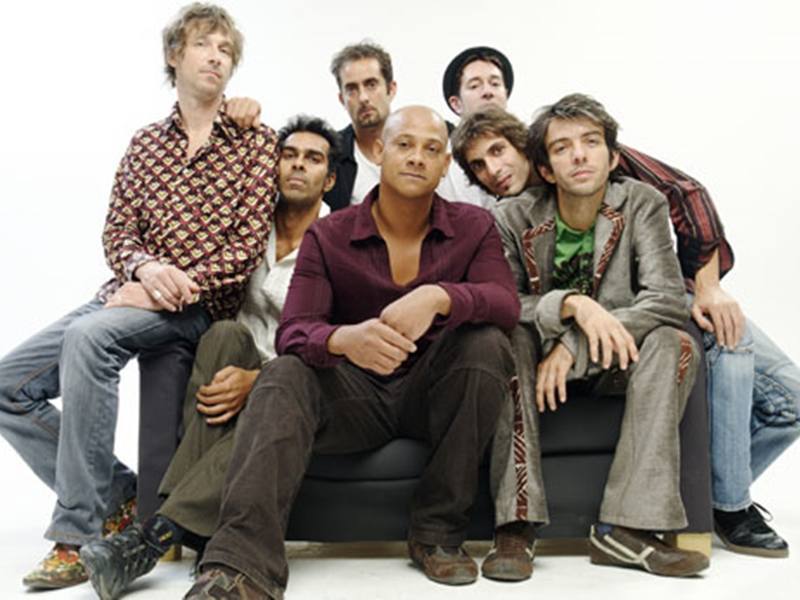
Fanga
For the last ten years or so, the collective 'Fanga' has been on the up,blending afrobeat, jazz and funk and playing a music that is eminentlyspiritual. Fanga means 'strength of conviction' in Dioula and the commitmentof the group is emblematic of its name.An alliance of complementary personalities and cosmopolitan energies,Fanga first took form in 1998. Returning from Africa, Serge Amiano bringsback a few vinyls of the likes of Fela, CS Crew and CK Mann that he plays tothe Burkinabese rapper Korbo. Amiano being a hip-hop producer naturallytakes on the role of the group's artistic director right from the start.The discovery of this urban African music of the 1970s quickly forms thebasis of a shared passion. In 2000 the album 'Black Voices' by Tony Allendefinitively seals Fanga's birth and its afrobeat foundations with an obviousorientation towards dance and the solid relationship between the eightmembers of the group.Fanga brings out its first six tracks in 2001 with a minimal rhythm section.Joined by the bass player Rajaneesh Dwivedi and the drummer SamuelDevauchelle, the group records 'Afrokalyptik' in 2003, its first album. Thefollowing album 'Natural Juice', out in 2007, highly praised by Gilles Petersonas well as the New York magazine, Wax Poetics, establishes the group'sstylistic grounding, catching a lot of attention. In Spring 2009 they record athird album 'Sira Ba' ('The Long Road'), much acclaimed by such magazinesas World Sound and Vibration. The wave of radio attention went as far as aselection FIP and a Radio Nova playlist.Alternating drawn-out lyrical climaxes, explosive brass passages, killer riffsand melodic ease, 'Sira Ba' displays a powerful force of conviction, reflectingan uncompromised musical complicity and an impressive flow of energy.Julien Raulet's guitar work reacts perfectly with the keyboards of DavidRekkab and the percussion of Eric Durand.Having played with Antibalas, Seun Kuti and Kokolo, Fanga has nurturedsolid relationships within the international afrobeat community. In thestudio, the group's path crosses that of Tony Allen and the sadly demisedSegun Demisa, both pillars of Fela Kuti's Africa 70, as well as that of theiconoclastic rapper Mike Ladd, the Jamaican Winston McAnuff infuses areggae accent in I Go On Without You, whereas the Togo All Stars Orchestrashines out like a thousand fires on Dounya, one of the strongest and mostjubilant of the album.Fanga launches its live project on stages across Europe, the JazzoviaFestival in Poland, The Global in Denmark, The Afrodisia in Rome and theFela Days tour in Spain (Madrid, Seville, Saragosa), as well as at Solidays,the live 'Nuits Zebrés' on Radio Nova, Jazz sur Son 31, Jazz sous lesPommiers, Festival Coueleurs Urbaines, Africajarc, the Tribu Festival, andJazz en Ouche to name but a few.Despite being firmly rooted in certain Nigerian and Ghanean musicaltraditions (those of the 1970s' afro-beat and high-life) Fanga is equally athome to musical concoction, as demonstrated by the samples and other hiphopand electronic ingredients, not to mention the vocals in Dioula, Englishand French. The gritty horns and earthy analogue keyboards shape thegroup's sound whilst Korbo has no hesitation in embracing his Mandingueroots.
Flowing without restraint, Fanga exudes both spirituality and an intensepersuasive power. It is home to an iron fist, characteristic of the most proudand organic of black musics. Melodious and hypnotic, the pieces developedby the group not only strive towards a groove conducive to a state of trancebut is also equally appealing to the mind.Whilst avoiding lengthy discourses, revolutionary messages and thepretension of offering answers to the problems of the world, Korbononetheless poses serious lines of reflection, in particular, defending theright to be different as well as nurturing a deeper harmony betweenhumankind and nature. He denounces the social injustice arising from thepyramidal economic structures that have become uncontrollable andegotistical. Newspaper headlines often inspire Fanga’s songs.Brought up on the raw energy of hip-hop, the group reposes equally oncertain values that even today can only be found in Africa, a sort of candourand instinctive sense of rhythm which lends such freshness to Fanga. Thisurge to respond when faced with a base emotion, however fleeting, hasgoverned their musical progression since the beginning of the 2000s.Fanga takes on an entire dimension on stage, as those who’ve had thechance of seeing the group live can only agree. Once fallen under the spell ofthis strength of conviction, all that remains is to dance. Afrokaliptyk Nation,their first live album and DVD reveals their strength on stage and the extentof the ground they have collectively covered. A faithful record of thisimpressive evening the 4th December at the 'Victoire II', Montpellier, thislatest album looks very promising.
The musical performance by Fanga is part of the Multiculturalism in Music project realized with the support of the the Culture Programme of the European Union.